

|
Interruptions to critical business processes, whether due to
hardware faults, production breakdowns, communications failures or
insufficient – or even non-existent – protection against voltage
fluctuations, can have far reaching consequences. After all, system
availability and the reliability of IT infrastructure platforms are
decisive factors for the efficiency and productivity of company
processes – and thus equally for business success.
Miniaturization and the ever greater performance of the hardware
components place new demands on modern power management concepts.
The answer to this dilemma: Power management with RimatriX5. The
demands with regard to redundancy, scalability and maximum
availability are bundled into a single system. Together, the
solutions help to reduce operating costs and boost the availability
of the overall system. It is even possible to retrofit new modules
without interrupting operation.
Particularly effective: The “n+1” technology, which ensures optimum
redundancy and enhances availability. Indeed, the Power Modular
Concept (PMC), with its innovative distributed parallel architecture
(DPA), stands for ultimate system availability.
The power management product range for power distribution in the
data centre is based on the consistent implementation of plug-&-play
expansion – with no need to interrupt current operations. Downtimes
are avoided and future operating costs are lowered.
Power System Module (PSM)
Busbar
-
Fully wired with shock hazard protection
-
Two supply circuits for redundant configuration
-
Loads up to 48 A or 96 A
-
Active power system module
-
Remote power supply administration via SNMP and HTTP
-
Current measurement and display
-
Slot switching and user administration

Power System Module (PSM)
Plug-in modules: Various country-specific versions &
Retrofitting without interrupting operation
Optimum cable management: Space-saving integration into
the rack also serves to cut installation costs
Power Distribution Rack (PDR) and Power
Distribution Module (PDM) for power management between IT racks
-
Power Distribution Rack:
Local distribution up to 250 A permits connection of eight PDM
systems
-
Expandability:
Expandable without interrupting operation
VDE-tested shock hazard protection
Direct supply-side connection to the PSM busbar
-
Flexibility:
Cable-based connection to the PSM busbar for maximum planning
flexibility
-
Power Distribution Module:
Local power distribution up to 40 kW in server and network
enclosures
4 fused three-phase outputs, 3 x 400/230 V, 16 A each
-
Redundancy:
Redundant infeed with option of mechanical locking
Power Modular Concept (PMC) for power
supply protection
PMC provides innovative protection against power supply problems.
Through the combination of modularity (scalability and redundancy)
and distributed parallel architecture (DPA), it guarantees maximum
availability for critical applications.
Thanks to the modular DPA system architecture, it is possible to
expand capacities and stored energy times without interrupting
operation.
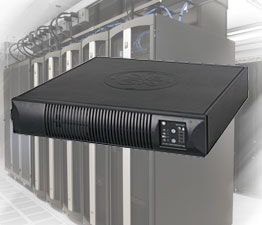
Single-phase UPS, power range 1 – 6 kVA
-
High-quality double-conversion technology with optimum sine-wave
output voltage
-
Battery expansion for extended stored energy time
Intelligent battery management monitors battery readiness and
guarantees system availability; furthermore protection against
overcharging and exhaustive discharge.
-
Scope of delivery offers software compatibility for all standard
operating systems
-
System load reduced by preventing continuous server polling
after shutdown
Three-phase UPS, power range 10 – 120 kVA
per rack
-
Performance/modularity/redundancy
PMC is a new three-phase UPS concept offering modular “n+1”
redundancy on the basis of double-conversion technology. The
modular configuration permits capacity expansion through the
integration of additional hot-swappable UPS modules.
-
PMC modules
PMC modules for the power classes 10, 20, 30 and 40 kVA are
prepared for 482.6 mm (19˝) installation in TS 8 server racks.
-
Maximum availability
The “n+1” system architecture means that there are always at
least two modules able to share the critical load. If any module
should fail, the other modules automatically take over the whole
connected load without interruption.

"n+1" System Architecture
Integration of up to 3 modules in the IT
rack or separate battery enclosure
Modules can be retrofitted on a hot-swapping basis, without needing
to switch the system to a bypass. Stored energy times can be
tailored to the individual application.
DPA
The distributed parallel architecture comprises integrated control
electronics for rectifier, booster, inverter and static bypass. The
CPU, furthermore, possesses parallel intelligence for enhanced
reliability.
|