




Data Center Power, Server Room Power and Computer Room Power Management
Efficient Data Center Power Configurations
Many data centers predate the industry’s focus on efficient technologies. From design through technology selection and installation, initial costs and uptime were the focal points because power was not a major expense or energy availability a consideration. Concerns about costs related to power consumption and the impact of the data center on the environment had not entered the corporate consciousness.
Today, energy is an issue, a big issue. US data centers consumed 61 billion kWh of electricity in 2006 and an estimated 70+ billion kWh of electricity in 2010, while an estimated 70% of the electricity in the U.S. is generated by fossil fuels. The economic and environmental consequences render some legacy server room designs irrelevant and wasteful. The legacy 480V-208V power distribution architecture is a prime example. The components (UPS, PDU, and server power supply) are older and lose roughly 40% of the incoming electricity during transformation and distribution.
In its defense, this power distribution approach was designed with a minimal power envelope in mind. Its inefficiencies are amplified in the context of high density installations, where rack loads can conceivably eclipse 30kW.
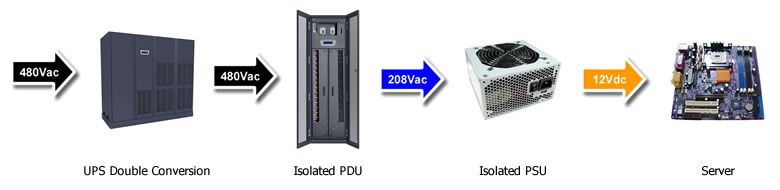
Improved AC Power Distribution
Data centers can no longer afford to waste 40% of incoming electricity. For this reason, they are investigating new power technologies and distribution designs. Modern architectures achieve overall efficiencies between 80-90%; according to the Green Grid, a 4% difference exists between the most and least efficient. In addition, performance curves for newer equipment are steeper and better sustained across the loading curve, making them significantly superior at lighter loads.
Some Typical AC Distribution schemes:
480V-208V Power Distribution (Present Day)
The present day 480V-208V distribution design is the same as its predecessor, except it uses the highest efficiency components on the market today. The overall efficiency, depending on the load, ranges, between 80%-85%, a significant improvement over the legacy computer room design.
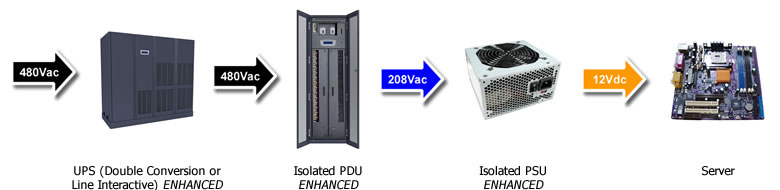
600V-208V Power Distribution
600V-208V is most commonly used in Canada and closely resembles the present day 480V-208V design. The only difference is the higher input voltage into the UPS. The overall efficiency of the design ranges also between 80-85%.
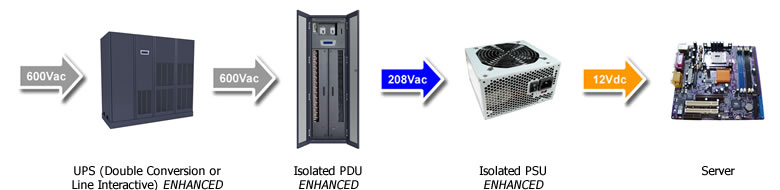
480V/277V Power Distribution
This power scheme distributes electricity in a three-phase Wye configuration at 277V-the phase to neutral voltage in 480V 3 phase power. Instead of stepping down to 208V, the voltage remains constant through the PDU, improving the efficiency of design. This power distribution scheme achieves efficiencies between 85-90% depending on the load and is considered the US equivalent of 400/230V and 415/240V, though currently server power supplies are not readily available to accept 277V.
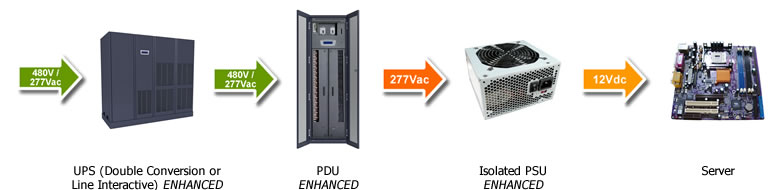
415V/240V Power Distribution
This design is typically employed outside the United States. Since most US facilities have 480/277V available, they would have to convert to 415V at the UPS level. This scheme is another high efficiency approach, achieving 85-90% efficiency based on the load.
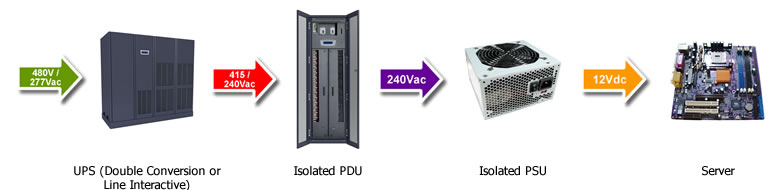
DC Power Distribution for the Server Room
The last few years have seen a renewed interest in distributing Direct Current (DC) power throughout the data center and server room. There are multiple points, including the UPS and server power supplies, where incoming AC power is converted to DC. Losses occur during each conversion, the severity of which depends on the equipment. Proponents see DC power distribution as a way to minimize electrical losses, thus achieving a more efficient design.
Here are some of the DC Power Distribution Schemes:
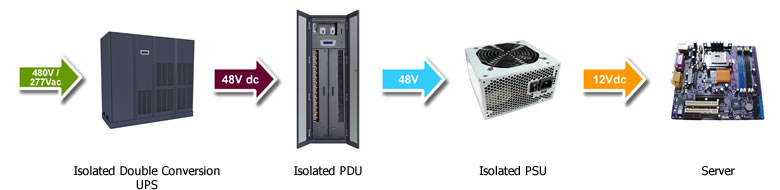
480Vac to 48Vdc Power Distribution
The 48Vdc power distribution design is most common in telecom deployments. It achieves efficiencies of 85%-90% based on the load.
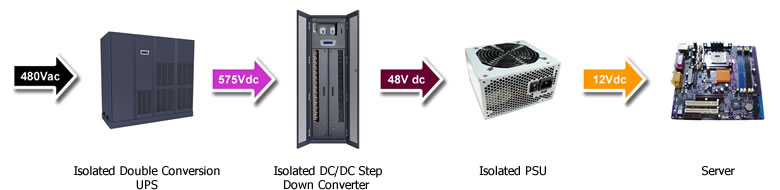
480Vac-575Vdc-48Vdc Power Distribution
This design distributes 575Vdc power from the UPS to minimize distribution cabling losses and cost. The efficiency levels, like most of the other present-day designs, ranges from 80% to 85% depending on the load.
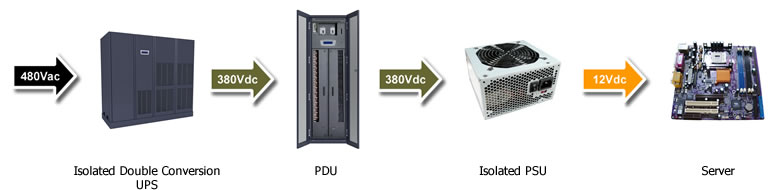
480Vac-380Vdc Power Distribution
This design distributes 380Vdc to the server power supply, achieving greater efficiency and minimizing losses in the distribution cabling. It achieves 90% at 30-50% of capacity with the overall efficiency decreasing slightly as the load nears full capacity. 380Vdc has been widely discussed in the industry. Mark Monroe, Sun Microsystems’ former Director of Sustainable Computing, had this to say on the topic: “So we decided to run the datacenter at 380 volts of DC power. Now, DC power is more dangerous than AC power, so there are safety issues, and we had a hard time finding electricians to hook up the 380 volt DC power”.
If Sun had difficulty finding qualified electricians, it’s reasonable to assume that the majority of data center professionals don’t have a background in 380Vdc. The lack of trained personnel could present a safety issue for those working with the power components.
Conclusion
New, enhanced technologies are available that improve efficiencies in server room power distribution. The latest UPS systems and PDUs achieve efficiencies in the high nineties, while some server power supplies have reached or exceeded the ninetieth percentile.
These best-of-breed technologies, however, may be in stark contrast to the equipment already within a data center. In a 2008 whitepaper, Lawrence Berkley National Labs estimated “a typical AC system in today’s data center would have a UPS that was about 85% efficient, and power supplies around 73% efficient.” For these existing data centers, the question remains: In terms of complexity and cost, how feasible is it for a legacy data center to employ next generation power distribution?
The simplest exercise would involve a hardware refresh. If an organization, due to tax incentives or corporate protocol, refreshes its hardware every 3-5 years, the latest server products may be shipped with highly efficient power supplies. If the LBNL projections are correct, the improved power supplies would have a noticeable impact on the overall power distribution efficiency.
DC distribution, the subject of the LBNL whitepaper, seems most suited for new or specialty data center applications. Though the most efficient of the designs we discuss above, a wholesale change to DC distribution is impractical for an existing data center. And before DC power distribution would even be viable for a new facility, especially the highly efficient 380Vdc design, the market must support it. There are no rack power distribution products or server manufactures that support 380Vdc power (though some are available at 48Vdc telecom voltage).
One of the Top 10 recommendations of Data Center Pulse, an end user group, asked for server power supplies to support 277Vac, which would eliminate the intermediate transformer loss between the UPS and the load. 277V is the phase to neutral voltage of 480V 3 phase power. In addition, a prominent power/cooling manufacturer believes worldwide standard 400/230Vac would rival the best DC design in efficiency and would be far less complex to operate.
The lesson learned is that any improvement to components in a conventional 480-208Vac design results in greater efficiency. A running change to the power distribution scheme, however, may be impractical for an existing server room facility due to complexity and the risk and cost of prolonged downtime. A green field data center is well poised to take advantage of the latest product advances and architectures.

References
Lawrence Berkeley National Labs. (2008). DC Power for Improved Data Center Efficiency. Berkeley: Lawrence Berkeley National Labs: http://www.lbl.gov/Science-Articles/Archive/EETD-DC-power.html
Rassmussen, N. (2007). AC vs DC Power Distribution for Data Centers. Retrieved March 2, 2009, from APC Corporate Site: http://www.apc.com/whitepaper/?wp=63
Sun Microsystems. (2007, March). Sun Microsystems is Building Energy Efficient Data Centers. Retrieved March 23, 2009, from Sun Microsystems: http://www.oracle.com/us/corporate/citizenship/sustainability/datacenters/index.html
The Green Grid. (2008, December 1). Quantitative Efficiency Analysis of Power Distribution Configurations for Data Centers. Retrieved March 10, 2009, from The Green Grid: http://www.thegreengrid.org/Global/Content/white-papers/Quantitative-Efficiency-Analysis
Server Technology, Inc. (2008, August 21). 3-Phase Power in the Data Center. Retrieved March 17, 2009, from www.ServerTech.com http://cdn1.servertech.com/assets/documents/documents/236/original/3-Phase_Power_in_the_Data_Center.pdf