

Real-Time Monitoring &
Efficiency Benchmarking

Data Center Efficiency Services
Real-Time Monitoring & Efficiency Benchmark


Real-Time Monitoring & Efficiency Benchmarking

The 42U data center Real-Time Efficiency Benchmark (REB) solution is a thorough analysis of the data center. The REB combines 42U expertise with real-time monitoring technology that establishes an energy efficiency benchmark, Power Usage Effectiveness (PUE), for the data center.

Visualize your data center & realize savings through:

  • Customizable Wireless Sensor System
  • 24x7 Environmental & Power Monitoring
  • Cooling Capacity & Efficiency Measurement
  • Real-time temperature, humidity, pressure, and dew point imaging
  • Historical Trending Analysis
  • Interactive monitoring dashboard

REB Deliverable: All data points aggregated into a cogent report that quantifies energy use, potential savings, and return on investment (ROI).

This solution allows clients to identify energy efficiency improvement opportunities, measure the return on investment (ROI) for data center energy efficiency programs as well as compare their energy efficiency to other data centers.

This solution is based on the 42U Efficiency Measurement Life-CycleSM process. This five phase cyclical process provides the insight and guidance required to systematically improve data center energy efficiency. The first cycle through the phases results in a concrete efficiency baseline measurement and recommendations for energy efficiency programs to consider.

Phase 1: Survey
The first phase is a non-invasive inspection and data collection effort, performed with the client's data center and facilities staff to ensure security and operational guidelines are met as well as to help the staff to gain a deeper understanding of energy efficiency best practices. The data gathered includes floor plans, sub-system design documents, equipment configurations, operational settings and data center management objectives.

Phase 2: Planning
The 42U team then develops an instrumentation plan. This includes a measurement point design that determines the data and locations that will be monitored. The data collected in the survey phase is used to populate the monitoring system database. A timeline is developed that ensures the appropriate technical staff is available as required for the installation phase. Security and other considerations are included in the plan.

Phase 3: Installation
Once the design and timeline are approved the 42U team then configures and tests the sensor and network designs. The equipment is then shipped to the client for installation in the data center. The 42U team deploys the sensor, network and monitoring technologies. Finally, the 42U team tests and verifies that the monitoring system is operational and accurately collecting data.

Phase 4: Measure
This is the real-time data collection phase. 42U works with the client to ensure that data is collected accurately and the client becomes familiar with the capabilities of the monitoring system and management software. At the end of the agreed-upon measurement period the client provides 42U with a copy of the monitoring database. The 42U team then analyzes the data and produces a report based on the site inspection, staff interviews and sensor data. The report includes the following sections as appropriate:

Executive Summary

Project Overview

  • Project Scope – Define the coverage of the project to ensure expectations are correctly established
  • Sensor Solution – Describe the configuration of the sensor solution

Thermal Data

  • Thermal Map – Provide a color-coded image showing temperature ranges throughout the data center
  • Overcooling – Use thermal map and cabinet data to identify areas where cooling levels are below ASHRAE standards
  • Overheating – Use thermal map and cabinet data to identify areas where cooling levels are above ASHRAE standards
  • Air Mixing – Identify areas where heated air is infiltrating the chilled airflow
  • Thermal Anomalies – Describe anomalous thermal findings

Air Conditioning System

  • Air Flow Assessment – Evaluate air volume, velocity, cold air supply and hot air return
  • Bypass Airflow – Identify conditions where chilled airflow is returning to cooling equipment without cycling through IT equipment
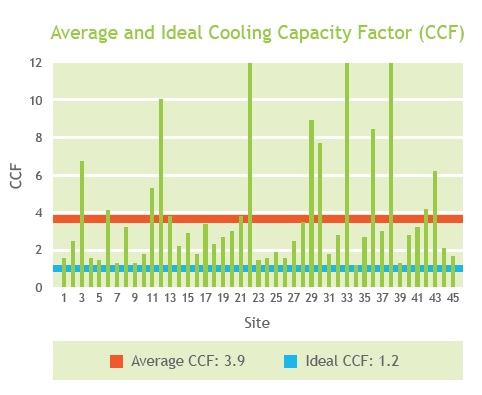
  • Cooling Infrastructure Capacity Analysis – Evaluate total cooling capacity relative to current and planned usage
  • Cooling Infrastructure Operational Behaviors – Identify inefficient operational behaviors
  • Overhead Ducting Analysis – Evaluate sub-system for inefficiencies
  • Plenum Pressure Analysis – Identify issues that can impact equipment availability or performance
  • Plenum Pressure Map – Provide a color-coded image showing pressure ranges throughout the plenum
  • Raised Floor Analysis – Evaluate raised floor system for strength, seismic design, electrical noise levels and grounding best practices
  • Relative Humidity Data – Identify situations where relative humidity is not compliant with ASHRAE standards
  • Relative Humidity Map – Provide a color-coded image showing relative humidity ranges throughout the data center

Electrical System

  • Power Infrastructure Capacity Analysis – Evaluate total power capacity relative to current and planned usage
  • Power Infrastructure Operational Behaviors
  • Standby Generators – Evaluate generator capacity relative to current and planned equipment loads
  • UPS – Examine maintenance and testing strategy as well as assess redundancy attributes

Infrastructure Observations and Measurements

  • Cable Management – Evaluate cable sub-system for airflow blockage situations
  • Fire Protection – Assess viability of fire protection system and impact on hardware if activated
  • Overhead Ducting – Evaluate the airflow in ducting or opportunity for conversion of false ceiling space as a return airflow plenum
  • Raised Floor – Test the floor structure for strength, seismic design, electrical noise levels and grounding best practices

General Environmental Conditions

  • Cleanliness – Physical inspection of the data center that identifies situations and practices that can contribute to excessive particulate matter and other issues
  • Electromagnetic Interference (EMI) – Evaluate the environment for magnetic fields that can effect equipment performance
  • External Environmental Considerations – A more broad review of the site and installation that identifies external conditions that can cause data center performance issues, such as microwave transmission towers generating interference
  • Noise Levels – Measure ambient noise levels to ensure OSHA compliance
  • Radio Frequency (RF) Emissions – Determine presence and level of high frequency interference from wireless devices
  • Security – Evaluate site security relative to industry standards

Energy Efficiency Assessments

  • PUE – Establish a value for and describe the implications of this widely recognized efficiency benchmark from The Green Grid that enables comparison across data centers
  • Data Center Infrastructure Efficiency (DCiE) – Establish a value for and describe the implications of this widely recognized efficiency benchmark from The Green Grid that enables comparison across data centers

Efficiency Improvement Recommendations

  • PUE/DCiE Improvements – Identification of specific steps that can be taken to improve these measures
  • Sub-Systems – Sub-System-specific recommendations that will improve efficiency and reliability

Conclusion

Phase 5: Reconfigure
The final phase of the cycle is the delivery and review of the report. The report is first delivered to the client for review. A meeting is then scheduled where the 42U team presents the findings and recommendations.

This rigorous assessment provides an excellent starting point for determining how to improve data center energy efficiency and reliability. In addition, it provides guidance for prioritization of efficiency projects.


Contact us to find the best Efficiency Service for your data center.
Data Center Consultation
Our engineers can help you select the best Efficiency Solution.
Click here or Call 1-800-638-2638 for a free energy efficiency consultation.


Home About 42U Careers Clients Vendors Press Articles Efficiency Glossary Site Map Efficiency Calculator
Data Center Resources UPS Power Remote Power KVM over IP Rack Accessories Efficiency Best Practices Lights Out


Data Center Efficiency Service - Real-Time Monitoring and Efficiency Benchmarking