




Applying Data Center Performance Measurement to Mitigate Challenges
Abstract:
Measuring data center performance is vital to maintaining the network and system availability that internal customers expect. Data center managers need to be able to track and assess equipment availability, assess and manage critical facilities, and measure data center energy consumption. Monitoring solutions, remote management products, and industry-specific metrics can help datacenter managers measure performance, proactively identify and mitigate potential issues, and improve the overall organizational bottom line.
Organizations increasingly depend on their IT infrastructure to support mission-critical activities. IT personnel are held accountable for managing this infrastructure and data center performance measurement is a vital tool in maintaining high performance and delivery. From assessing and ensuring the availability of critical facilities, monitoring geographically dispersed environments, and improving the overall organizational bottom line, IT personnel require tools that allow them to measure performance and proactively identify and mitigate potential issues. Several industry-related publications and groups have noted the importance of data center metrics, and have named the need to measure data center performance as a key issue for 2006 and 2007. (1)
Recommended Data Center Performance Measurements and Solutions
Issue #1: Ability to Track and Assess Equipment Availability
For most organizations, the cost of server or network downtime is significant and internal customers expect network and system availability of “Five Nines” or 99.999% (2). On a daily basis, IT managers need to be able to assess availability/reliability of equipment and all external components that support operations, so that they can reduce downtime, identify and mitigate issues, and provide a secure environment for an organization’s mission-critical equipment. IT professionals also need an effective way to review historical trends to identify equipment or systems that need to be redesigned or replaced.
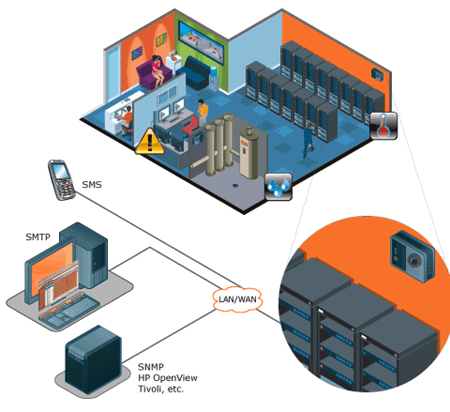
Meeting the Challenge: Environmental monitoring solutions provide real-time feedback about critical systems with continuous, proactive monitoring of all pertinent factors including temperature, amperage draw, humidity, dew point, and physical security. These solutions allow administrators to set thresholds for environmental conditions and send alerts securely via e-mail, text message, or SNMP if said thresholds are exceeded. In addition, environmental monitoring systems provide valuable historical reports, alert information, and logs that allow administrators to identify trends and adapt practices accordingly. This data can help with statistical analysis, modeling, and forecasting.
Issue #2: Ability to Assess Availability/Reliability of Critical Facilities
When assigning critical resources, IT professionals need to determine the highest-priority sites and facilities. Several organizations have proposed systems to help administrators classify and rate their facilities. For example, the Uptime Institute applies a four-tier classification system based on factors such as fault tolerance, useable capacity, sustainability, and concurrent maintainability (3). As another approach, the Syska Hennessy Group provides a seven-level criticality classification system that aims to help data center managers evaluate facilities that are vital to the mission of their organizations and provides a framework to help assess potential data center vulnerabilities (4). After determining critical sites, administrators need to be able to implement appropriate management and control systems.
Meeting the Challenge: Enterprise management solutions, such as KVM over IP or service processor aggregation appliances, provide administrators with 24/7 access to servers, serial devices, remote power, and other equipment both locally and remotely. These solutions provide BIOS-level access to mission-critical equipment, reducing system and network downtime by enabling immediate access to failed resources and centralizing data center management. These solutions also provide visibility to daily operations and occurrences through comprehensive audit logging and reporting tools. Enterprise-level management tools provide redundant architecture, including primary failover access at both the hardware and software levels.
Issue #3: Ability to Measure Energy Consumption in the Data Center
Across almost every industry, rising data center power consumption and heat are major issues, particularly as organizations are incorporating blade servers and high-density server racks into their IT infrastructures. Many organizations are studying how power consumption can be reduced in the data center. For example, the EPA is studying ways to make computer servers and data centers more energy efficient, and is considering a possible ENERGY STAR designation for servers and other data center equipment. (5) The Green Grid, a newly formed non-profit consortium of information technology companies, is proposing the use of Power Usage Effectiveness (PUE) and Datacenter Efficiency (DCiE) metrics, which would enable IT personnel to estimate the energy efficiency of data centers, compare results against other data centers, and determine if energy efficiency improvements need to be made. As defined by the Green Grid, Power Usage Effectiveness (PUE)= Total Facility Power/ IT Equipment Power; Datacenter Efficiency (DCE)= IT Equipment Power/ Total Facility Power. (6)
Meeting the Challenge: Utilizing PUE and DCE information, IT personnel can begin to evaluate their own energy efficiency. Using these metrics, as well as application-specific data, data center managers should start to consider ways of reducing data center power consumption. Standalone data centers can also use the EPA Energy Star building performance rating tool, Portfolio Manager, to rate a facility’s energy performance in comparison to similar facilities (at the whole-building level). Some answers include transitioning to 208V or three-phase power provisioning. Higher voltage power reduces amperage requirements, allows equipment to operate more efficiently, and can reduce the amount of hardware required. IT personnel should conduct a thorough audit of equipment, determine if any servers can be consolidated or discarded, and clean up any clutter under the data center floor, such as cabling, that might be impeding air flow. The use of blanking panels and cable management accessories in the rack can also assist in these efforts.
How Can The Latest Technologies Help You Improve Data Center Performance?
The team at 42U specializes in needs assessment, solution design, and implementation support to ensure that IT professionals maximize their use of current technologies to improve overall business performance. 42U provides complete remote management solutions, including KVM over IP, intelligent power, environmental monitoring, rack cooling, and rackmount solutions. A 42U sales engineer can help you improve your data center performance by helping you select solutions that are most appropriate for your organization’s particular needs and environment.
Read More about Key Data Center Metrics and How they are Applied
References:
Stansberry, Matt, “Top Ten Data Center Stories of 2006”
MacKinnon, Chris, “How Is Your Data Center Performing? A Metric To The Madness. and “Optimizing Datacenter Performance and Building ROI: The TeamQuest Approach”, IDC/TeamQuest
Brill, Kenneth; Pitt, Turner; and Seader, John. “Tier Classifications Define Site Infrastructure Performance,” Uptime Institute
Burkhardt, Jerry and Dennis, Richard. “Assessing criticality levels in the data center”, Data Center Management Advisory Newsletter
“Enterprise Server and Data Center Energy Efficiency Initiatives”
“Green Grid Metrics: Describing Datacenter Power Efficiency”